 |
ABOUT RWANDA KNITSRwandans Allied for Peace and Progress (RAPP)The Rwanda Knits program in Rwanda is a program of RAPP, a Rwanda-based NGO (non-governmental organization). Its offices are located on the top floor of Sunrise House, in the Remera section of Kigali. Gedeon Bihonzi, RAPP’s Executive Director and Amini Kabano, Manager of Administration and Finance, and Patrick Nimubona, RK’s Project Manager and the RAPP staff handle all aspects of the two major programs under its management: Kunda Ubuzima (Love Life), a program that focuses on HIV-prevention and behavior modification communicated through the performance arts, and Rwanda Knits, a program for women artisans’ economic sustainability. The Rwanda Knits program is managed by Project Manager Patrick Nimubona. RK founder, Cari Clement, is on the Executive Committee board of RAPP. By way of information, RAPP was formerly called Rwandans and Americans in Partnership (RAP). Our SuccessesOctober 29, 2010 — RK receives word it has been awarded $40,000 from the Yahoo Employee Foundation. October, 2010 – The IKU management receives training in planning: how to coordinate and plan for production based on orders and projections, ordering raw materials, calculating production requirements and time, delivering the order, etc. Rwanda Knits also receives over $2,000 from the Three Rivers Crochet Group, proceeds from their Yarn Ball benefit party. August – early October, 2010 — Through a connection with the knitwear designer for Anthropologie, Indego Africa (IA) secures and order for 750 snoods (aka druid hoods or cowls) to be sold by Anthropologie in their stores and online. Production of the order starts in late August and ships to the US early October. Cari assisted in the design and pattern-writing of the snoods and consulted in the yarn to be used for the production. IA facilitated and financed the production of the order. August 5, 2010 — Rwanda Knits (US) receives a $5,000 grant from the Oswald Family Foundation, for the purposes of establishing a yarn bank so the knitters will always have a financial reserve for the purposes of ordering yarn for the production of school uniform sweaters. April, 2010 — Volunteer Lulu Winslow uploads the Ingenzi Knit Union’s website: www.ingenzi.com. March, April 2010 — Former Director of Cooperative Development, Laura Hanson, and RK founder, Cari Clement, travel to Rwanda, bringing 4 laptops and lots of support to the knitters. Cari, Laura and Patrick met with the management of the Ingenzi Knit Union to assist them in writing a grant to USADF (US Africa Development Fund). Through secret ballot, the members elected a 5-member grant-writing team. The team worked very hard through a number of versions of the application and through numerous interruptions. The IKU submitted its application to USADF in September of 2010. January to August 2009 — Laura Hanson, Rwanda Knits' Director of Cooperative Development, returned to Rwanda to resume her work with the knitting groups. She was also instrumental in hiring Rwanda Knits’ Program Manager, Patrick Nimubona. Laura and Patrick assisted a number of knitting groups to register as income-generating knitting cooperatives with their Sector, then District and National governments. Laura met her goal in registering a minimum of three registered primary cooperatives to become a cooperative union (CU).
The Ingenzi Knit Union was formed in May, 2009, and began working together as a group on an export project for the Inshuti label on June 1. The advantage of the PC’s forming a Union is efficiency of scale, division of labor and responsibilities, segmentation of the market and certain raw materials importation advantages. In March, 2009, the potential members of the CU and representatives from other cooperatives attended a four-day Sales and Marketing workshop conducted by Centre Iwacu and funded by donations from Dining for Women (www.diningforwomen.org). Laura returned to the US late August, leaving Rwanda Knits in the capable hands of Patrick Nimubona. One of Patrick’s first challenges after Laura left was to fill an order for 820 scarves in 5 different patterns and in 3 to 5 colors each, but the challenge was met and each knitter earned between six and eight times the average daily wage. 
In 2008, the knitters made 2,000 scarves for export for the reality star, Whitney Port’s, Collection. These scarves were featured in an article about Rwanda in the March 2009 issue of Fast Company. The scarves discussed in the article and shown in a photograph, were made by the Rwanda Knits-supported Susukura cooperative at Millennium Villages in Bugesera. May-August 2008 — Volunteer cooperative specialistc from Oregon, USA, Laura Hanson, arrives in Kigali to learn from the Rwandan Cooperative Task Force how she can be of assistance in providing cooperative training to Rwanda Knits' 29 nascent cooperatives and to those knitting groups who want to become cooperatives. With her skill, knowledge and determination to help, Laura has made many friends in the world of Rwanda cooperative training and, by the time she leaves Rwanda (temporarily) mid-August, she will have facilitated the registration and training of four Primary Cooperatives and help to put together Rwanda's first artisan Secondary Cooperative training, being conducted by Centre Iwacu, Rwanda's oldest and most experienced cooperative training organization. Laura and all the Rwanda Knits staff — especially the knitters themselves — are very grateful for the encouragement and enthusiasm of their local District Cooperative Officers without whose assistance and support the registrations and training would have been very difficult to conduct before Laura leaves Rwanda. Laura plans to return to Rwanda early 2009 to work with the remaining cooperatives to elevate the standard of living for all Rwanda Knits members. Rwanda Knits continues to grow in collaboration with other local and international organizations, most recently partnering with the Millennium Villages Project (MVP) to create a new group of knitters in Mayange District. Over 80 women are currently participating in a two-month-long technical training on the machines. Once this training is complete, the MVP knitters will form the 29th Rwanda Knits cooperative — and work with other Rwanda Knits groups fill their first order, a line of scarves for a new celebrity label. January, 2008 — Rwanda Knits is growing quickly with the original 17 associations in the process of forming 29 knitting cooperatives around the country. Within the next couple months, Rwanda Knits will become Rwanda Knits, Ltd, the first and only women-owned "Secondary Cooperative" (a large, for-profit business owned entirely by its members) in the country. Most of these women are the very poor, a significant percentage who cannot read or write — but can knit.
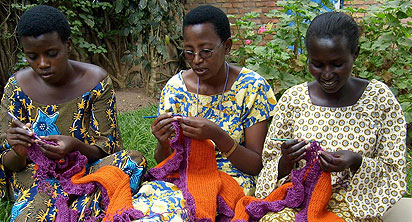
Knitting has changed the lives of these women. From a January 28 meeting with representatives of many of the cooperatives, here are some examples:
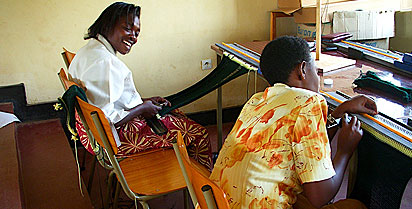
And when each group was asked what they needed most? It wasn't money, it wasn't more yarn — it was training in quality control and in product development (design). The government of Rwanda is focusing its efforts on building sustainable businesses and cooperatives, especially for women and especially in crafts. UNIFEM (United Nations Development Fund for Women), a Rwanda Knits partner, is planning to use Rwanda Knits as the model for other women's craft cooperatives around the country. Other Rwanda government officials are looking at the project similarly. June, 2007 — The knitters have received orders for over 2,500 school uniform sweaters, 400 gorilla trekker caps (to sell to tourists) and other items. In May of 2007, Rwanda Knits received a donation that paid for the yarn, a durable, washable 100% acrylic, produced in Turkey, to fill many of the orders. The yarn has been ordered, shipped and received and distributed among all the 16 women groups around the country who are using small amounts of it to make samples from which to secure orders. The knitting groups are also beginning the process of registering as for-profit cooperatives, as required by Rwanda law. Rwanda Knits will ultimately become an umbrella cooperative owned by each of its member groups. It will handle all administrative responsibilities, most sales and marketing functions as well as the financial ones that apply to all its member cooperatives. It will also handle ordering and distribution of yarn, expanding Rwanda Knits to include new cooperatives, working with the government, etc. It will ultimately be funded by an administrative percentage charged to each of its member cooperatives. April, 2007 — The Rwanda Knits knitters presently number nearly 1,500. As of this writing, four of the associations have received orders for over 1,000 sweaters for school uniforms. Other orders are pending. The Dian Fossey Center women are planning to knit and sell gorilla trekker hats to tourists. Other groups will be selling sports team caps. Others are focusing on knitting for newborns. With Rwanda's very cool nights, sweater wearing is very common, as evidenced by the school uniform sweaters. May, 2006 — Together with members of the Business Council for Peace (BPeace), Clement returned to Rwanda to help facilitate a 4-day business training seminar for representatives of the 17 associations. This training session was in partnership with BPeace, UNIFEM (United Nations Development Fund for Women) and RAP (Rwandans and Americans in Partnership). Clement conducted additional knitting training including felting and embroidery on knits. August, 2005 — While awaiting the arrival of the machines from the USA, the Rwanda Knits teachers worked with Clement to learn new teaching and knitting techniques. Clement also met a number of the associations who would be receiving the machines, plan for when the machines would arrive and do additional knitting training to prepare the Rwanda Knits teachers for training the women who would be receiving the machines. During this trip, Clement and the BPeace group traveled to Gisenyi on the border of Congo and spent time with the children of Imbabazi, an orphanage started by Roz Carr for survivors from the genocide. May 31, 2005 — RAP received a USAID (United States Agency for International Development) grant for $99,000 and Rwanda Knits was officially launched as a program supported by USAID. This grant provided for the purchase of over 600 knitting machines, accessories and training to Rwandan women. The machines would be divided among 17 associations to assist them in the creation of income-producing knitting cooperatives. FACED/Rwanda Knits also received a $2,000 grant from Aid to Artisans to purchase an additional 26 knitting machines. January, 2005 — Clement returned to Rwanda to assist in the production of two projects for EDImports, do additional knitting training and meet with USAID personnel to discuss a possible grant. They also met with Rwandan government officials and did knitting training with Congolese refugees at Gihembe camp in Byumba province. June 2004 — Clement and an associate returned to Rwanda to teach more production knitting techniques to both the Rwandan knitters and the refugee knitters at the Kiziba camp in Kigali. They also met with potential Rwandan partners and initiated, in partnership with EDImports, four production knitting projects for export. January 2004 — Clement and six associates returned to Rwanda with 30 more knitting machines, this time for Rwandan women in particular for AVEGA (Association of Widows from the Genocide). She also came with an income-producing project that netted the refugee knitters over $3,000. The knitted goods they produced were one of Rwanda's first exports under AGOA (Africa Growth and Opportunity Act) and served to encourage the government to become part of AGOA II. Project Manager, Geofrey Katushabe, was hired to oversee the project in Rwanda. He secured traveling instructors to teach, in their native language, other knitters in how to use the machines and in production knitting techniques. CSR and FACED established an office in Kigali and began to work on starting a Rwanda-based NGO organization, which would eventually become RAP. July 2003 — Clement and the USA for UNHCR mission traveled to Rwanda and trained over 100 women to use the machines. Prompted by a need to give back what was instilled in her by her mother, Cari Clement always wanted to help start a women's economic cooperative somewhere in the world. Clement, then president of Bond America, manufacturer of home knitting machines, contacted USA for UNHCR (United Nations High Commissioner for Refugees) and offered to donate 60 knitting machines and training to help set up a women's knitting cooperative anywhere in the world. Rwanda was first to reply and the machines were shipped late 2002. Market OpportunitiesThe major opportunity is the knitting of sweaters for secondary school uniforms. There are 579 secondary schools in Rwanda with a total student population of 239,629. Most of these schools are using school uniform sweaters and they source them from Uganda, Kenya or China, with a price of 7500Frw. If only 20% of these schools require uniform sweaters; this represents a potential market of 47,928 sweaters per year. With a price per sweater of 6,500frw (approx $12), the annual sales potential is nearly half a million dollars. Producing these sweaters domestically would keep 100% of the income from the sales of these sweaters in-country, creating a sustainable domestic economic base. Our FutureRwanda Knits will be applying for subsequent grants to enable it to continue to support the knitters, assist with the development of their business skills and expand the program to include more women. But it also needs the support of outside donors to match with the grant funding it receives, per terms of most US grants. With over a quarter million secondary school students in Rwanda, 80% of whom must have sweaters (currently purchased from China and Kenya) as part of their uniforms, the annual market for sweaters is nearly 48,000 per year. That will keep a lot of knitters very busy! And they all need your help and support. But the ultimate goal of Rwanda Knits is to enable the knitting
cooperatives to become totally self-sustainable through the implementation
of good — and fair — business practices so the current
knitters can train more knitters. As one woman said, "We want
Rwanda to be the Knitting Center of all of East Africa!" |
The OrganizationRwanda Knits is part of the Centers for Social Responsibility (CSR), a registered 501c3 nonprofit corporation. All contributions are tax deductible. |